JESUS2000 from jesus 2000 on Vimeo.
Tuesday, June 15, 2010

Sunday, June 13, 2010
Tuesday, May 18, 2010
A perk of...
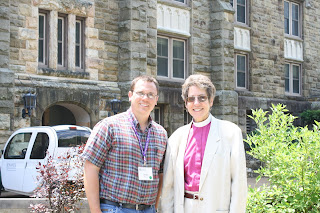
the three year, residential seminary: Picking up the Presiding Bishop of the Episcopal Church USA. How often does one get an 1.5 hour conversation with the PB?
Wonder is the beginning of all theology
This semester has been crazy. I bit off more than I could chew. I made a big mistake by taking on so much. I loved it all individually, but came to resent most of it collectively. This semester I really went against one of my core values: leisure. I hold leisure in high esteem, not because I am a slacker (which I can be) but because leisure is so very important. Simply having the time to reflect and make sense of life is the promise of the modern age, so why don't we make use of leisure? First there is this sense that we need to be productive and fill up our time. Second, the scale, not the pace which is often the culprit, of modernity is too big. We sometimes travel more in a single day than our great-grandparents did in their entire lives, we see to many images, and talk too much.
My spiritual director has assigned a time for me to stroll aimlessly each morning. I do this when everybody is still asleep, except the birds and the occasional frog. This time has reacquainted me with the pace and scale of human life: the walking footstep, the human hand.
This "getting slow and small" is the proper kind of prayer and where all theology starts. There is great lessons in seeing and experiencing a different perspective of time, this is really what meditation imparts.
Here's yet another perspective on time: objectively sppeding up to subjectively slow us down.
Iceland, Eyjafjallajökull - May 1st and 2nd, 2010 from Sean Stiegemeier on Vimeo.
Tuesday, May 11, 2010

Sunday, April 25, 2010
In Praise of Media
I'm getting into finals these days, but for some reason I have been more aware of my media diet. Usually I think if media as fat, tasty but it really ought to be taken in moderation. Indeed, in the past I have gone on media fasts, no reading of magazines, no news, no t.v. But these days I have been feasting, gorging, on media.
It is not a far cry to link the way that people use and create media and how we think about God. The best theology is a narrative, which is a media. For more on this see the Bible.
Here's a run-down of what I've been reading, looking at, and listening to:
Watch this, it's a good example of how little it takes to tell a full-blooded story.
My friend Mike sent me some comics. The first was American Virgin, a excellent story of a fundamentalist coming to terms with theodicy. The second was Invincible, the most lovingly rendered super-hero comic that I've ever read.
All this comic reading sent me back to the work of Scott McCloud, he is comics' greatest interpreter. Reading McCloud again, I just had to finally get his masterpiece, Zot!, and I did, it does not disappoint. Browse this beautiful collection right here:
If you are a snob and think comics have nothing real to offer, watch this.
Apart from Comics, I've been reading for classes, especially alot of Liberation Theology, Kenneth Leech in particular. I met Kenneth Leech when I interviewed at Sewanee, I think he is my hero.

I've also been getting into the Gospel according to John, in the greek. Instead of the blazing speed that I need get through the material for my classes, when I go through John, with my professor we go slow, sometimes spending 15-30 minutes on a single word. I always thought of John as strictly a theological document, but now i see it as a midrash on the Old Testament, told from this side of the Resurrection.

There is also this blog, and this blog, and don't forget this one.
Also I've been playing a storytelling game, over email, my friend Jonathan created. It has taught me about economy of language to convey as much information as possible, a technigue many preachers could learn alot from
There's alot more, but as you can see I've been a glutton...
It is not a far cry to link the way that people use and create media and how we think about God. The best theology is a narrative, which is a media. For more on this see the Bible.
Here's a run-down of what I've been reading, looking at, and listening to:
Watch this, it's a good example of how little it takes to tell a full-blooded story.
My friend Mike sent me some comics. The first was American Virgin, a excellent story of a fundamentalist coming to terms with theodicy. The second was Invincible, the most lovingly rendered super-hero comic that I've ever read.
All this comic reading sent me back to the work of Scott McCloud, he is comics' greatest interpreter. Reading McCloud again, I just had to finally get his masterpiece, Zot!, and I did, it does not disappoint. Browse this beautiful collection right here:
If you are a snob and think comics have nothing real to offer, watch this.
Apart from Comics, I've been reading for classes, especially alot of Liberation Theology, Kenneth Leech in particular. I met Kenneth Leech when I interviewed at Sewanee, I think he is my hero.
I've also been getting into the Gospel according to John, in the greek. Instead of the blazing speed that I need get through the material for my classes, when I go through John, with my professor we go slow, sometimes spending 15-30 minutes on a single word. I always thought of John as strictly a theological document, but now i see it as a midrash on the Old Testament, told from this side of the Resurrection.
There is also this blog, and this blog, and don't forget this one.
Also I've been playing a storytelling game, over email, my friend Jonathan created. It has taught me about economy of language to convey as much information as possible, a technigue many preachers could learn alot from
There's alot more, but as you can see I've been a glutton...
Tuesday, April 20, 2010
Richard Dawkins calls for arrest of Pope Benedict XVI
Hmmm...interesting idea from two media addicts.
Friday, April 16, 2010
Gospel of Venkman
John 3:31-36
“He whom God has sent speaks the words of God, for he gives the Spirit without measure.”
Invocation+
This evening we get a pretty good summary of John’s gospel in the mouth of…somebody. Who’s speaking anyway, John the Baptist, John the Evangelist, Nicodemus, Jesus? It really doesn’t matter, what matters is what is said. Essentially, the speaker says, God is God and the creation is the creation. The creation can’t comprehend God, God is utterly unknowable to the creation. Yet, God has revealed himself to the creation, to us, in Jesus. When we know Jesus we know God the Father.
This is the theme of John’s entire gospel. The writer never grows tired of saying, “The father and the son are one.” “All mine are yours and yours are mine.” “As you, father, are in me and I am in you, may they also be in us.”
What John sets up and reinforces throughout his gospel, from the beginning to the end and beyond, is that God’s holy spirit has been an ever-flowing stream in all creation, Jesus came to do the works of the Father and show God in the world, so that we might believe,
…and in believing…what? To receive the Holy Spirit and receive it without measure.
Bishop Spong says. . . and this will likely be the first and last time you will ever hear a quote from Bishop Spong from this preacher or this ambo, for that matter. But, Bishop Spong describes the indwelling of the Holy Spirit as an overflowing tub of water in a basement, there is no controlling where the water goes, and it gets all over everywhere, splashing under things and into the darkest neglected corners. God gives the Spirit without measure, it is all, and I mean all, or nothing. God is extreme in this instance, wasteful, decadent.
So when we believe through Christ, we become identified with Christ through the Holy Spirit, and with Christ, God.
So we believe that God became a person through the outpouring of the Holy Spirit. All Christians agree, I hope, that in Jesus Christ a bridge was made between God and humanity.
But that bridge. That bridge between God and us. Is it a one way bridge? Is the bridge between God and us just for the Holy Spirit to go down, from God to us? The ladder that the angels ascend and descend upon Jesus, is it just for angels or is it for us too?
What was Athanasius talking about when he said that, “God became human that we might be made god.”?
In the great American cinematic masterpiece, Ghostbusters, there is a scene that might have an insight.
It seems the Ghostbusters have tracked down the big bad, Gozer, a powerful lighting fingered demon-lady who greets the guys with, “Are you a god?”
One of the Ghostbusters considers the question and says, “No.”
Gozer answers, “Then die!” She zaps the guys thoroughly, leaving them hanging off a skyscraper.
Finally, one Ghostbuster says to the other, “When somebody asks you if you are a god, you say YES!”
We are all created in the image of God, and lest we forget, God is a trinity. The God image that we bear is the image of dynamic and spontaneous love. No matter what happens to us or what choices we make, that image of dynamic love can never be removed. But through God’s giving of the Spirit, without measure, just might make us gods too.
Now, before I get harassed for heresy. Let’s look at what capacity people might have for divinity. First we all bear the image of God. But since we are creations with a creator, we are distinct from God. God is outside of time and space and utterly Other. Yet this other God, reaches out to us.
The Orthodox say that we can know God’s energies, not his essence. We can seek and achieve union with God, yet we retain our distinctiveness, our personhood. Our union with God is sanctification, not annihilation. While we don’t become God in essence and nature, we can become divine by grace. By the grace of God.
In our western arm of the church, we would have been toast against the question, “Are you a god?” For our eastern brothers and sisters they say,”Yeah, that’s pretty normal.”
Of course we will all achieve our full deification upon the consummation of all things and us Anglicans love to proclaim the eschatological horizon of the church.
But Jesus, here in John’s Gospel, is repeatedly inviting us into the divine life NOW. Yes, we still sin, we still fall, but we don’t fall alone. We are made in the image of the triune God whose property it is to love; therefore our deification is possible when we live the Trinitarian life, a life with, and for others.
So, while we might not be fully ready to answer yes to the question, “Are you a god?” We might, through faith in the measureless pouring of the Holy Spirit, stand with Christ and say, “I’m with him.”
Subscribe to:
Posts (Atom)